A Slice of Wiener Life, According to an Ausländer
A Slice of Wiener Life, According to an Ausländer

An honour system. For riding the metro? This was something new. How can you allow people to just wander onto a platform without bothering to check their tickets? And what’s with pushing buttons or yanking handles to open the wagon doors?

These were some of my very early impressions when I first found myself in Vienna, back in the autumn. But while I couldn’t believe the city would organise itself this way – it seemed rather naïve – on the other hand, I still haven’t taken a free ride on the U-Bahn myself. I keep saying that I have never seen a ticket-checker (and it’s true that I haven’t). But I also keep telling myself that I can’t risk getting Vienna upset at me. She’s too pretty.

read the rest

“My Soul is Young”: An Encounter with Dr. Gerhard Freilinger

“My Soul is Young”: An Encounter with Dr. Gerhard Freilinger

Gerhard Freilinger is not your average doctor. He has led a life that is immediately enviable, but at the same time, one that has called for a great deal of courage. Having lived through wars and being exposed with the effects of conflict – both tangible and intangible – Dr. Freilinger has seen every side of both guns and operating tables in a whirlwind that has spanned seven decades. Nareg Seferian caught up with the man at the Kurdistan Regional Government representation in Vienna.

“I was born in Upper Austria, in Linz [in 1927]. I became a soldier at the age of fifteen,” Dr. Freilinger recalls. But his military career during the Second World War did not last long, as he ended up as a prisoner of war in Yugoslavia at just 17 years old. “I was in very, very bad condition after two and a half years of prison in Yugoslavia. I came home in 1946, very heavily damaged. My soul was sick, my heart was sick.”

Interested in being a doctor at a young age, Dr. Freilinger recalls how, at 12, he told his parents, “I would like to see this hospital [in Linz], but not only the operating room.” This was surprising to a family of lawyers. It was during his recovery in Salzburg, which took more than a year, where he decided to take on medicine as a profession. He finished with his schooling and then studied medicine at Innsbruck, followed by a fellowship in the United States. Notably, he ended up working in the field of plastic and reconstructive surgery, helping people deal with the physical scars of war. Continue reading

Media In Armenia: Fast Connections, Slow Change

The media in Armenia suffers from the same legacy as in much of the post-communist world. Although the Internet has shaken things up in the past few years, media independence is still in the making.
Media In Armenia: Fast Connections, Slow Change

As with most of the post-Soviet world, the Armenian press did not have much to go on in terms of a real journalistic tradition after the USSR collapsed. There may have been a lot of publications in the Armenian world-within the country and in the organized diaspora outside of it-but as far as the new Republic of Armenia was concerned, its journalists and broadcasters were coming out of decades of censorship when independence came in 1991. That legacy can be felt to this day, as numerous media outlets clearly toe the line of national policy, while others go to the other extreme of spreading scandals. Very few have the courage, the resources, and the professionalism to carry out objective and meaningful reporting. Continue reading

Forty Years on: Gourgen Yanikian and Us

Forty Years on: Gourgen Yanikian and Us

On Jan. 27, 1973, two diplomats of the Turkish Republic traveled to Santa Barbara, Calif., to meet with an individual claiming to possess Ottoman artifacts he wished to donate to the country for posterity. Mehmet Baydar and Bahadir Demir played into the hands of Gourgen Yanikian, who had planned their murder as an act at once of vengeance, of retribution, and of justice.

It is hard, as an Armenian today, to write about Yanikian without judging his actions using those three less-than-consistent characteristics noted above. Vengeance is not exactly a Christian concept, is it? Justice is ordered by a legitimate, recognized authority. As for retribution, well, it is not for no reason that “Operation Nemesis” was the name of the immense undertaking following the Armenian Genocide to do away with those responsible for that horrific crime: Nemesis is the Greek deity of divine retribution.

read the rest

Marash: remembering anew

Marash: remembering anew

Turkish Review occasionally opens its doors to students from outside Turkey, inviting them to stay for brief internships at our journal. This summer we were joined by Nareg Seferian, a young Armenian of Marashtsi lineage (that is, with Armenian roots in Ottoman Maraş) who received his education in India, Armenia and the US, where his studies have focused on law and diplomacy. During his time with Turkish Review, Nareg visited his ancestral town of Marash/Maraş. This is his account of that journey. Continue reading

The Latin Lovers of Armenia

Among the samples of Yerevan’s architecture is the bridge at the end of Kievian Street.

It unfortunately has the reputation of being a favourite drop-off point for the suicides of the city. Walking across it the other day, however, I saw a series of markings on the railings that evoke happier times and thoughts.

It appears that there is a young man who is quite infatuated with a young lady. So infatuated, in fact, that he can barely express his words … Continue reading

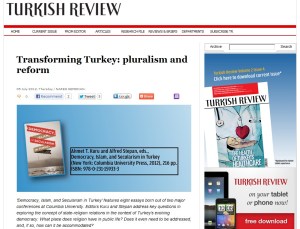
‘Democracy, Islam, and Secularism in Turkey’, By Ahmet T. Kuru and Alfred Stepan

‘Democracy, Islam, and Secularism in Turkey’, By Ahmet T. Kuru and Alfred Stepan

‘Democracy, Islam, and Secularism in Turkey’ features eight essays born out of two major conferences at Columbia University. Editors Kuru and Stepan address key questions in exploring the concept of state-religion relations in the context of Turkey’s evolving democracy: What place does religion have in public life? Does it even need to be addressed, and, if so, how can it be accommodated?

Let it be said once more: Turkey has changed a lot in recent years, especially over the course of the past decade. Alongside the nation’s economic growth, its society has witnessed significant transformations that have affected the way it views itself, as well as the way the world sees it.

What the Justice and Development Party (AK Party) has brought about is not simply policies that encourage the generation of wealth or more proactive steps in diplomacy. Turkey is undergoing a philosophical shift. Things are changing in a way that does not just make people feel better about themselves as Turks or as citizens of Turkey; rather, they are being made to re-evaluate the very basis of the Turkish state — what it means, where it has been, where it is headed. And that is not always an easy task, especially given étatisme’s importance as a tenet in the foundation and organization of the Republic of Turkey. Questioning the heretofore unquestionable can provoke powerful challenges. Continue reading

A ‘Close Creative Encounter’ between İstanbul and Yerevan

A ‘Close Creative Encounter’ between İstanbul and Yerevan

A creative format born in Japan that allows people to present and discuss ideas recently helped foster creative dialogue between two neighboring peoples who do not always see eye-to-eye: Turks and Armenians.

Pecha Kucha — Japanese for “chit-chat” — was conceived by two architects in Tokyo in 2003, originally as a means for young designers to showcase their work while giving them a chance to meet and network with one another. It has since grown immensely in popularity, with presenters from all artistic genres, and even academia, participating in regular franchised Pecha Kucha Nights in over 500 cities around the world.

Two of those cities are İstanbul and Yerevan. Organized with the support of USAID, the Eurasia Partnership Foundation and the Global Political Trends Centre at İstanbul Kültür University, the Yerevan Pecha Kucha franchisee — associated with Yerevan’s The Club, a well-known eatery that is not just a restaurant, but also a gallery and gathering space — worked together with the İstanbul franchisee, 34 Solo, a design consultancy, to put together what was described as “probably the first” inter-city, international Pecha Kucha Night, entitled “Close Creative Encounters.” Continue reading

A Good Day for Homophobia in Yerevan

A Good Day for Homophobia in Yerevan

There has been much talk of the LGBTI community in Armenia lately. A bar, widely considered to be a gathering spot for those who think and act differently than most in this country, was recently firebombed and vandalized. The violence was condemned in large part only by the LGBTI community and its supporters, until two ARF MPs acted on behalf of the assailants, posting bail for them pending trial. That gave way to greater attention and greater condemnation, particularly in the diaspora—including by several leaders and opinion-makers associated with the ARF.

Partly in response to that event, a conference on LGBTI tolerance issues took place in Armenia last week. It was poorly attended–perhaps by 20 or 30 people at most–though supported by European bodies and the UN. And on Mon., May 21, a rally in support of diversity and tolerance was planned on the occasion of the World Day for Cultural Diversity for Dialogue and Development, but also not too far on the calendar from the International Day Against Homophobia and Transphobia, which is marked on May 17. Both events were spearheaded by an NGO known as PINK (“Public Information and Need of Knowledge”), alongside other civil society groups.

read the rest

Song and dance moves to Armenia

Song and dance moves to Armenia

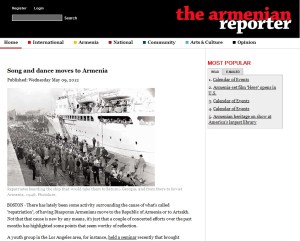
BOSTON – There has lately been some activity surrounding the cause of what’s called “repatriation”, of having Diasporan Armenians move to the Republic of Armenia or to Artsakh. Not that that cause is new by any means, it’s just that a couple of concerted efforts over the past months has highlighted some points that seem worthy of reflection.

A youth group in the Los Angeles area, for instance, held a seminar recently that brought together interested parties and organisations that do work in Armenia. Such activities are truly informative and helpful to the community out there. But the sort of effusive representation of life and times in Armenia that comes up and of “repatriation” can sometimes be a little over the top. Continue reading