Tanking Up on Music and Activism: Serj Tankian in Yerevan

Tanking Up on Music and Activism: Serj Tankian in Yerevan

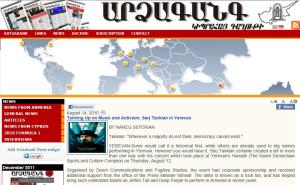
YEREVAN (A.W.)—Some would call it a historical first, while others are already used to big names performing in Yerevan. However you would have it, Serj Tankian certainly created a stir in more than one way with his concert at Yerevan’s Hamalir (the Karen Demirchian Sports and Culture Complex) on Thurs., Aug. 12.

read the rest

Tanking Up on Music and Activism: Serj Tankian in Yerevan

YEREVAN—Some would call it a historical first, while others are already used to big names performing in Yerevan. However you would have it, Serj Tankian certainly created a stir in more than one way with his concert which took place at Yerevan’s Hamalir (The Karen Demirchian Sports and Culture Complex) on Thursday, August 12.

read the rest

Tanking Up on Music and Activism: Serj Tankian in Yerevan

YEREVAN-Some would call it a historical first, while others are already used to big names performing in Yerevan. However you would have it, Serj Tankian certainly created a stir in more than one way with his concert which took place at Yerevan’s Hamalir (The Karen Demirchian Sports and Culture Complex) on Thursday, August 12.

read the rest

Surreal, Funny, Extraordinary…Armenia!

Surreal, Funny, Extraordinary…Armenia!

Any person who has spent time in Armenia will have a story—or seven—to recount. I find that, in all my years in the country, I have come across some pretty interesting occurrences. All right, maybe “interesting” is too broad a word to use, but such mini-adventures in the Homeland can be anything from simply funny to downright surreal.

read the rest

On Museums & The Shoe

On Museums & The Shoe

Museums always overwhelm me. There’s often so much stuff, I can’t get past the quantity of content and, what’s more, the massive quantity outweighs the value of each item for me. I remember first feeling this way when I visited the Imperial Treasury Museum in Vienna. The room at the entrance there had diamonds and rubies and emeralds and sapphires, and it was really cool. But then, the second chamber had diamonds and rubies and emeralds too, and the third one had tonnes of gold and silver, so much so that all that treasure actually felt commonplace and boring very quickly. I would love to have for myself, at home, any one of the samples of whatever artifact or item a museum displays. But to see so many things at once I find off-putting and distracting.

And then, who has the time and patience to go through each of the items and displays anyway? Another thing which really bothers me – and this is something I have come across in many places in America – is the prevalence of dumbed-down explanations. Of course, each item is probably worth a tome in itself, so no few paragraphs could really justify it, but, with displays going the other extreme, I have felt my intelligence insulted at times. In the same breath let me say that my favourite museum experience was in the States as well, at the Masonic memorial to George Washington in Alexandria, Virginia, right by DC. Small, short and sweet. There is always a guide, the tour lasts about an hour, and one gets to learn much about George Washington and Freemasonry, presented in a no-nonsense way. Nothing super technical, nor overly simplified reading material in large print. Straightforward, leaving one with the feeling that one could not have gotten anything particularly more out of the experience. I’ve been twice.

I went to see the shoe recently. What is “the shoe”? Much as referring to “the queen”, in a lot of the English-speaking world anyway, almost immediately implies the one at Buckingham Palace, in the Armenian world the definite article with that definite piece of footwear has been referring to one and only one shoe for the past month and more. It is over five thousand years old, and was discovered in an archaeological dig at a cave in Armenia. It made headlines all over the place and has been designated “the oldest shoe in the world”. Now, dealing in shoes is sort of a traditional Armenian line of work, my own grandfather and great-grandfather included in the ranks of Armenian craftsmen of that variety, so this discovery seemed rather apt. Apart from that more romantic connection, the technical stuff, the form of the shoe, for example – an enclosed, laced leather case, rather like a moccasin – is of genuine scientific and historical value as the earliest such specimen yet discovered.

The shoe is on display at Armenia’s National Museum, right on Republic Square in the heart of the capital, Yerevan. I had been here some years ago but, as I say, I often force myself to visit museums, so I hadn’t been back in a long time. To see the shoe was the big deal and motivating factor to go there now. And, hey, since I would buy the ticket, I might as well see the whole thing, right?

First, the bad stuff. It is not as well-organised a place as it could be. The locations of the galleries are not intuitive, and there is no helpful map or pamphlet to guide the way. It is housed in the same grand structure which also holds the National Gallery, and I can easily imagine a tourist getting confused, wandering from one to the other. There were hardly any plaques or explanatory notes in foreign languages, and the few in English were terribly technical, worded in such a dull manner. Who needs to know about apses and arcs, or the types of wood or clay something is made of, really ? Tell me what it is first of all, in plain English, what it was used for, which famous person might have touched it at some point, interesting things like that.

But there was plenty of really cool stuff too. Although I complain of being overwhelmed, it is in that overwhelming atmosphere that I realise yet again the antiquity and wealth of the history and culture of the Armenian people. Certainly I am aware of all that, but perhaps it takes some overwhelming to truly realise it. Many Armenians are entirely ignorant of their own richness, but I am sure things will come to the fore and be more prominent over time. Nothing is ever lost, I like to believe.

There were two ancient wagons, for example, dug out of burial mounds, alongside ancient sculptures, carvings, pottery, millennia old quite literally, and also… gigantic phallic symbols. Yes, I was so embarrassed. There were five of them – huge, really – and no mistaking what they were, either.

There was one area devoted to maps and the appearance of Armenia on maps from the most ancient times. I love maps, especially old ones. An Armenian researcher has come out with a couple of books specifically on this subject over the past few years, and it is truly fascinating. The oldest map in the world – again, without exaggeration – something out of Mesopotamia, includes Armenia (the only place marked on that map which still exists), along with everything the Greeks and Romans and Arabs and Italians, Dutch, Spaniards, English and Portuguese came up with. Really sweet.

And, no surprise of course, there were items of truly historic significance, like the throne of Catholicos Simeon Yerevantsi, who headed the Armenian Church in the eighteenth century. There were old books, something I like just as much as old maps, a decree of Catherine the Great in establishing the Armenian city of Nor Nakhichevan in Russia, a model of the ruins of Ani, the desk of Hovhannes Katchaznouni, a prime minister of the first Armenian Republic of 1918, old clothes, coins, carpets, and – my favourite, for some reason – everyday items from a century ago, including products with Armenian brands, certificates and diplomas for the same. There was a poster advertising $200,000 worth of bonds for the Armenian Republic in Armenian, Georgian and Russian, doors from Echmiadzin which looked like carpets inlaid with sedef (mother-of-pearl) …

The National Museum in Armenia was really cool, and the whole thing cost only a thousand drams (less than three US dollars). And the shoe? Well, to be honest, I expected something a little bit over-the-top, or at least an extra special corner or podium for it. But no, it was just there, among ancient vessels, by a sacrificial hearth and some weapons perhaps. Rather small (I guess we Armenians have been on the short side for thousands of years, then), in a little glass display. A single shoe, a very singular shoe indeed, just another artifact of an ancient people with ancient feet.

It was all by itself, though, unlike most other shoes, so it felt like there was something missing. Five thousand five hundred years is a long separation for any pair, but it must be especially hard for one’s solemate.

Some Light Warning

Some Light Warning

I have been exposed to a new phenomenon over the course of this past month or two of travels on the road in Armenia, that of flashing one’s headlights to approaching cars to warn them of police up ahead. It works quite simply: if you are in a car, and a car coming towards you on the highway flashes its headlights for a moment, that means there is a cop not too far away.It had never occurred to me that such a practice existed, only my friend Zareh pointed it out during a road trip as something which is common in Iran as well.Coming back from Gyumri recently – in a car which had, by the way, a radar detector! – this flashing got me thinking: what’s the point? So what if the cop is there? Well, straighten yourself out. Drive within the speed limit. Wear that seat belt.

But these are laws, and laws ought to be followed anyway. If you are breaking them, it’s good for the police to catch you and fine you for it. This is the idealist speaking, of course. We all know that laws can be over-careful to the point of being impractical, and that the cops can be in pursuit of other things in their policing.

So, this headlight-flashing phenomenon, is it in fact citizen policing, as a friend suggested, that is to say, diligence on the part of citizens towards one another as a gesture of goodwill?

Or is it a case of honour among thieves? All the drivers in the world are conspiring with one another, then, to gain advantage over the police. Not so much “put on your seatbelt” as “have your too many passengers in the back bend low and hide”.

Or is it a reaction towards ineptitude and corruption from the police themselves?

I imagine it is a little bit of each of the above. I would love to know just how widespread this practice is, though. Armenia and Iran are apparently on the list, but is it a regional thing, a Soviet thing, a Middle Eastern one…? Does it exist even in countries with a strong tradition of rule of law?

A funny note on which to end. As with many roads in mountainous Armenia, I was recently on a bus going on a highway that was twisting and turning through ridges and passes. A car approaching us flashed its headlights, just as it took the turn and noticed the cops hidden from its view because of the bend in the road. The driver, realising what had happened, did not miss a beat and immediately raised his arms in greeting, saluting to the police as the car sped by. I guess the cops need some light warning from time to time as well.

Armenia and Georgia, Reading into Georgia and Armenia into Reading

Armenia and Georgia, Reading into Georgia and Armenia into Reading

I never tire of comparing Armenia with other countries, and what a better object for comparison than neighbouring Georgia? The two peoples and states share much in common, not the least of which is the immediate Soviet heritage.I have been to Georgia on a few occasions, but this last trip was extra special. First of all, it was for the particular occasion of participating in summer classes in the style of St. John’s College, put together for the third year by OLEG – the Organisation for a Liberal Education in Georgia. It went very well.Apart from the classes, I got to stay with a family and do touristy things beyond Tbilisi, which was where I had spent all my time in the country before. Georgia has a gorgeous countryside, ancient churches and monasteries, delicious food and warm hospitality… all that good stuff. But I also got acquainted much more than I had before with the language, culture and religion, and – of course – politics and society. Continue reading

Exotic emotions

Exotic emotions

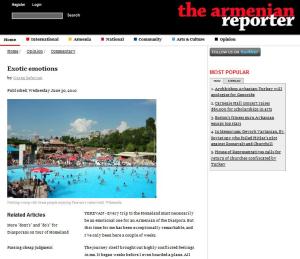
Every trip to the Homeland must necessarily be an emotional one for an Armenian of the Diaspora. But this time for me has been exceptionally remarkable, and I’ve only been here a couple of weeks.

The journey itself brought out highly conflicted feelings in me. It began weeks before I even boarded a plane. All that was on my mind was Armenia, Armenia, Armenia. My suitcases were on my floor maybe a month before the end of the academic year. I really wanted to leave St. John’s, Santa Fe, the States, and make it back to the Homeland for what I knew would be an exciting summer. Continue reading

The Rule of Normal | «Նորմալը» հայերենում

The Rule of Normal

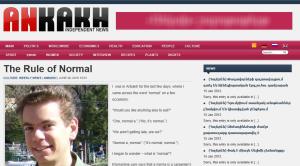
I  was in Artsakh for the last few days, where I came across the word “normal” on a few occasions.

“Would you like anything else to eat?”

“Che, normal a.” (“No, it’s normal.”)

“We aren’t getting late, are we?”

“Normal a, normal.” (“It’s normal, normal.”)

I began to wonder – what is “normal”?

read the rest

«Նորմալը» հայերենում

Վերջերս Արցախում էի, որտեղ մի քանի առիթով «նորմալ» բառը հնչեց:

– Ուրիշ բան կուզե՞ք ուտել, պատվիրե՞մ:

– Չէ. նորմալ ա:

– Չենք ուշանում, չէ՞:

– Նորմալ ա, նորմալ:

Սկսեցի մտածել, թե ի՞նչ է այս «նորմալ»-ը:

կարդալ մնացածը

More “dont’s” and “do’s” for Diasporans on tour of Homeland

More “dont’s” and “do’s” for Diasporans on tour of Homeland

SANTA FE, N.M. – If you are an Armenian of the Diaspora, and you are going to visit the Homeland for the first time, there are a few things you ought to know.

The sentimental expectations vis-à-vis Armenia are often left unfulfilled, especially for those of a very patriotic and traditional Armenian background. Be prepared for a general culture shock. Continue reading

Capturing a face

Capturing a face

Capturing a face – an Armenian face – is more than just re-presenting with art the wrinkles and dimples that accent a look. It is a look, after all, which glances back over three thousand years. It is the face at the crossroads of the Middle East, the Caucasus and the Mediterranean world.

An Armenian face has looked upon the kings of Assyria and Parthia, and the armies of Greece and Rome. It has withstood the onslaught of Arabs, Mongols, Turks and Russians. An Armenian face has witnessed war, earthquake and genocide.

An Armenian face has also been warmed by golden sunrises and sunsets, and cooled in the crisp air of the mountains of Ararat. It has quenched its thirst by the Tigris and the Euphrates, and cleansed itself in the Arax. It has beheld a thousand and one churches in Ani, and closed its eyes in prayer for a thousand and one years and more at Echmiadzin.

read the rest


A Race for the Census!

A Race for the Census!

I just filled in the US Census 2010.

I first heard about the Census through an ad at a cinema. It irked me immensely that the Census expects people to fill in the form and mail it back to them. How reliable a system of data-collection is that? To ask common people to take that much trouble, even with, say, free postage?

Sorry, I have a low opinion of the masses that way. In India the census is taken door-to-door. Granted, most of India’s population is illiterate, and, to be honest, I would also doubt the accuracy of India’s census, simply due to the massive scale of the exercise, but I nevertheless find greater appreciation in that sort of an effort. (By the way, India happens to have a census this year as well, as does Russia. A friend thinks it’s because having them in “-10” years is more aesthetic.)

So I started off with scepticism when it came to the US Census. Soon afterwards, however, I came to discover that we would be filling them out here at St. John’s College, and that actually excited me. I had never done something like that before. Did it matter that I am not a citizen or resident of the States? No, everyone is counted. Politics and society is one of my major interests, and, due to a variety of circumstances, I haven’t ever even voted, so filling out a census form got my civic senses all enthusiastic. The last time I had a similar rush was when I was an elections observer in Armenia’s parliamentary elections in 2007.

Scepticism, excitement… and then, confusion. The form itself was mind-numbing, and I say that in an unconventional sense of the word, because it numbed my mind with its simplicity. It took literally less than a minute to fill. All it asked was one’s name, date of birth, age (yes, for some reason, both “date of birth” and “age”), an address… oh, and a good HALF of the form was dedicated to “race”.

Quite literally half. First it asked whether the respondent was Hispanic or not, and then it had further categories for each. For some time now, Armenian-American organisations have been urging Armenians in America to fill in the Census forms as “Some Other Race”, specifying “Armenian”. I found this controversial from the beginning, given the clear distinction between ethnicity and race, and how, truly, if one considers all native peoples of Europe, the Middle East, even the Indian subcontinent as “white”, Armenians ought to answer, in fact, “white”. The political basis for the efforts appealed to me, however, and I did my duty.

But that the Census form mostly asked about race was what stayed with me from the entire deal. I thought America was supposed to be the land of… well, I don’t know, “assimilation”? “Equality”, perhaps? Not to say that the question itself indicates institutionalised segregation, but the fact is that the country’s census devotes a great deal to the issue of race, and I would even say that this is the case at the expense of other, arguably more relevant questions, such as level of education or occupation, about which, I believe, it was the practice in the past to enquire.

As far as I am aware, older census forms were much, much longer. I don’t know whether or not census officials went door-to-door back then, and I understand the greater expense and burden on the population to do so, but this is a very, very important national, civic phenomenon, so, frankly, I came off a little disappointed.

The US Census will know me forever as an “Armenian” by “race”, but what the implications of that are, in legal terms, or as a reflection of American society, I am uncertain.