Glimpses into the ARF Photo Archives: The Gougounian Group

Glimpses into the ARF Photo Archives: The Gougounian Group

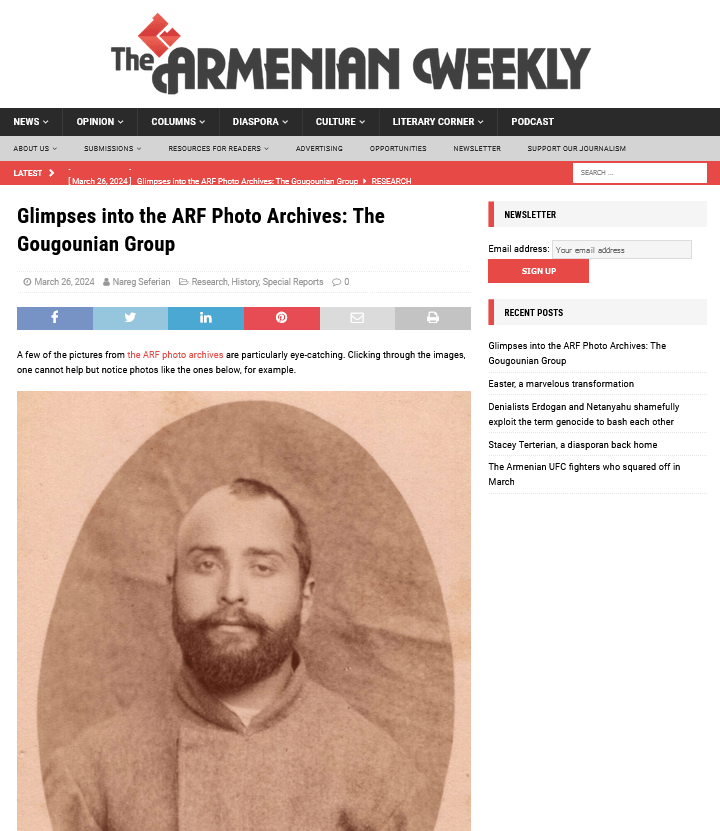
A few of the pictures from the ARF photo archives are particularly eye-catching. Clicking through the images, one cannot help but notice photos like the ones below, for example.

At first, it seems almost comical, as if it was a fad once upon a time for young men to shave the right half of their heads while keeping heavy beards and mustaches. Upon closer inspection, though, one notices a uniformity in what these men wore as well, and facial expressions that do not suggest a willful participation in the proceedings.

The captions and notes on the backs of the photos reveal the secret. These are four participants of the Gougounian Expedition – a tale from the turn of the 20th century worthy of a movie that has more or less gotten lost in the epic history of the Armenian people.

read the rest

Glimpses into the ARF Photo Archives: Armenian Legionnaires Immortalized

Glimpses into the ARF Photo Archives: Armenian Legionnaires Immortalized

In this series of brief glimpses into the ARF photo archives, I have tried to share with you thought-provoking, fun or other kinds of take-aways from the collection. This article is about a more specific episode of Armenian history – the Armenian Legion of 1916-1920 and its heroic volunteers, or gamavors.

Originally formed as the Légion d’Orient under French command, the units evolved into the Légion Arménienne serving alongside French and British forces as they fought Ottoman troops at the end of the First World War, moving up the Levant or eastern coast of the Mediterranean. The Western powers took over the Holy Land, Lebanon, Syria and Cilicia thanks to the efforts of the Armenian Legion among their ranks.

read the rest

Caucasus Analytical Digest No. 136: Iran and the South Caucasus after the Second Karabakh War

Caucasus Analytical Digest No. 136: Iran and the South Caucasus after the Second Karabakh War

Special Editor: Nareg Seferian
Authors: Elaheh Koolaee, Ahmad Rashidi, Alexander Yeo, George Sanikidze, Nareg Seferian

The papers in this issue address the regional dynamics following the Second Karabakh War of 2020. Iran has found itself having more and more of a foot in the South Caucasus as a result. The prospects and modalities of the so-​called ‘Zangezur Corridor’ (a proposed land connection between Azerbaijan proper and its exclave of Nakhchivan/Nakhichevan) include economic, geopolitical, strategic, cultural, and ideological components, perceived in various ways in Baku and Yerevan, in Tbilisi and Tehran. Besides the security outcomes and aftermaths since 2020, the contributions in this issue also take on historical developments and how they impact current bilateral ties.

access the issue

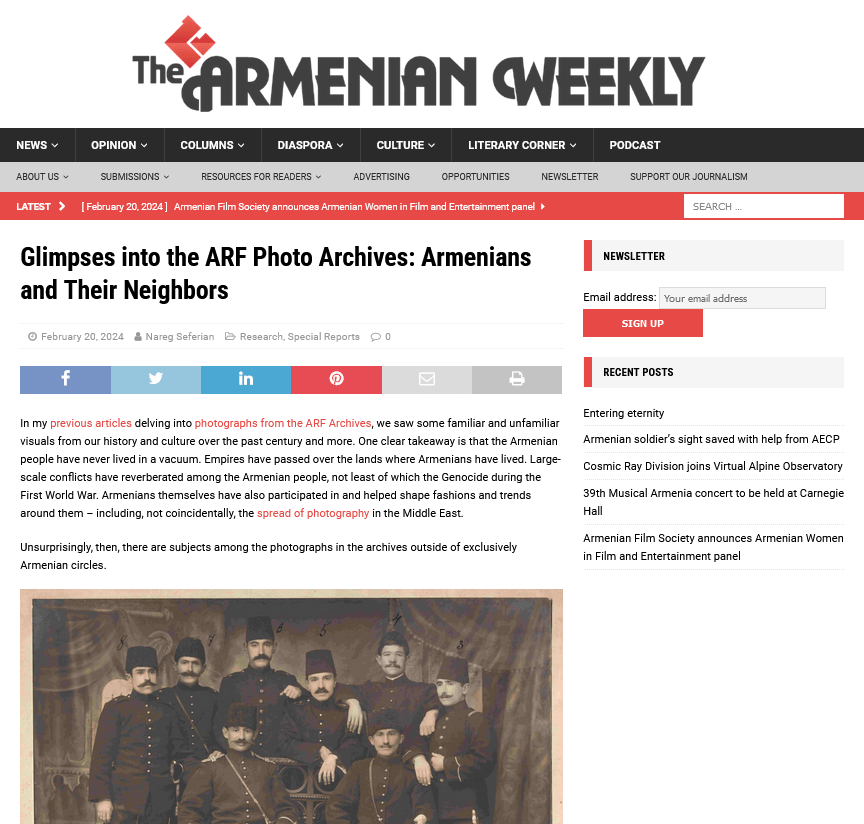
Glimpses into the ARF Photo Archives: Armenians and Their Neighbors

Glimpses into the ARF Photo Archives: Armenians and Their Neighbors

In my previous articles delving into photographs from the ARF Archives, we saw some familiar and unfamiliar visuals from our history and culture over the past century and more. One clear takeaway is that the Armenian people have never lived in a vacuum. Empires have passed over the lands where Armenians have lived. Large-scale conflicts have reverberated among the Armenian people, not least of which the Genocide during the First World War. Armenians themselves have also participated in and helped shape fashions and trends around them – including, not coincidentally, the spread of photography in the Middle East.

Unsurprisingly, then, there are subjects among the photographs in the archives outside of exclusively Armenian circles.

read the rest

Report in Short: A “Frozen Conflict” Boils Over

Report in Short: A “Frozen Conflict” Boils Over

On September 19, 2023, Azerbaijani forces initiated a massive attack on Nagorno-Karabakh, an Armenian-populated and effectively self-governing region inside internationally recognized Azerbaijani territory. Within 24 hours, the Nagorno-Karabakh leadership gave in, and, for the first time, Baku could claim full control over the contested territory. Despite being portrayed in the West as a “frozen conflict,” there had long been a risk of renewed violence in Nagorno-Karabakh. In this episode of Report in Short, Walter Landgraf and Nareg Seferian join Aaron Schwartzbaum to discuss their recent report “A ‘Frozen Conflict’ Boils Over: Nagorno-Karabakh in 2023 and Future Implications.

listen to the podcast

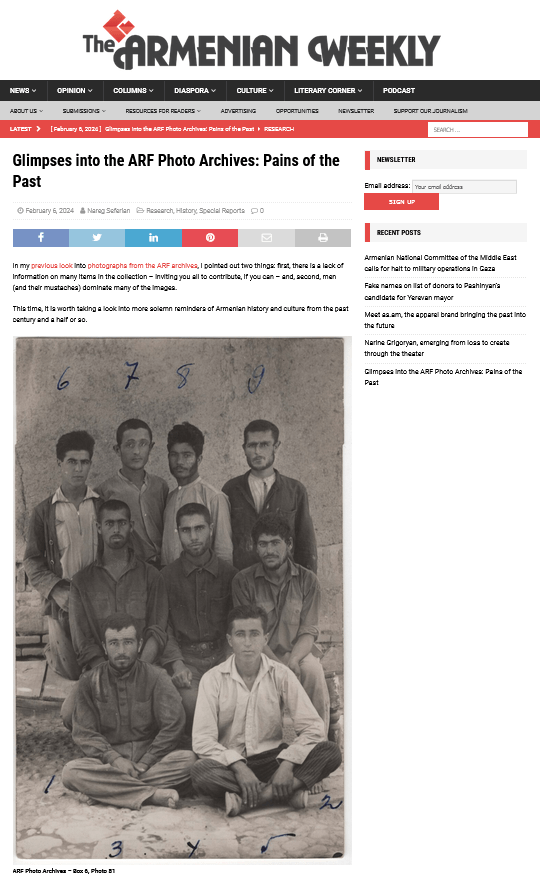
Glimpses into the ARF Photo Archives: Pains of the Past

Glimpses into the ARF Photo Archives: Pains of the Past

In my previous look into photographs from the ARF archives, I pointed out two things: first, there is a lack of information on many items in the collection – inviting you all to contribute, if you can – and, second, men (and their mustaches) dominate many of the images.

This time, it is worth taking a look into more solemn reminders of Armenian history and culture from the past century and a half or so.

read the rest

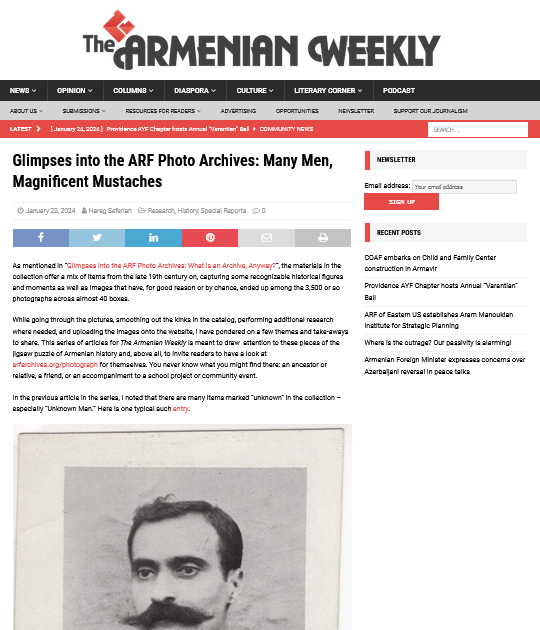
Glimpses into the ARF Photo Archives: Many Men, Magnificent Mustaches

Glimpses into the ARF Photo Archives: Many Men, Magnificent Mustaches

As mentioned in “Glimpses into the ARF Photo Archives: What is an Archive, Anyway?”, the materials in the collection offer a mix of items from the late 19th century on, capturing some recognizable historical figures and moments as well as images that have, for good reason or by chance, ended up among the 3,500 or so photographs across almost 40 boxes.

While going through the pictures, smoothing out the kinks in the catalog, performing additional research where needed, and uploading the images onto the website, I have pondered on a few themes and take-aways to share. This series of articles for The Armenian Weekly is meant to draw  attention to these pieces of the jigsaw puzzle of Armenian history and, above all, to invite readers to have a look at arfarchives.org/photograph for themselves. You never know what you might find there: an ancestor or relative, a friend, or an accompaniment to a school project or community event.

read the rest

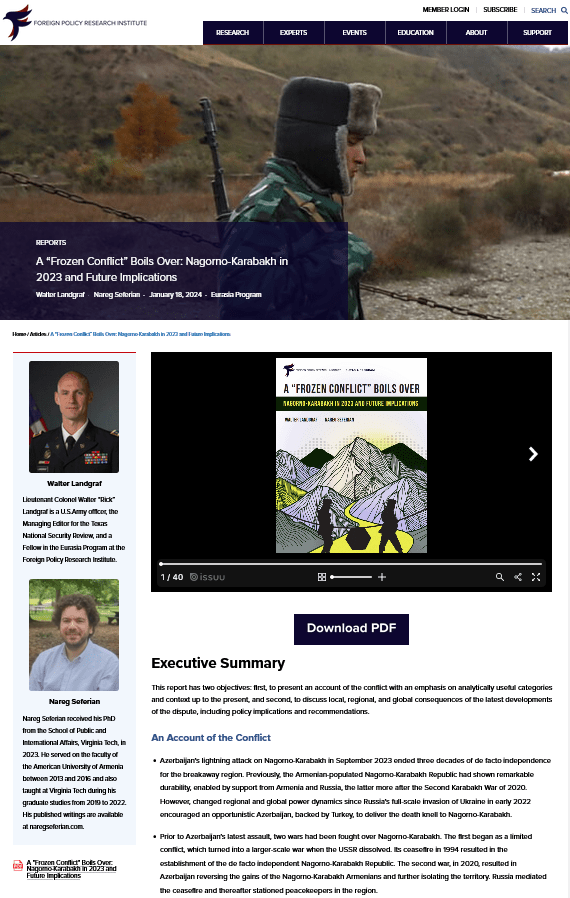
A “Frozen Conflict” Boils Over: Nagorno-Karabakh in 2023 and Future Implications

A “Frozen Conflict” Boils Over: Nagorno-Karabakh in 2023 and Future Implications

Walter Landgraf, Nareg Seferian

This report has two objectives: first, to present an account of the conflict with an emphasis on analytically useful categories and context up to the present, and second, to discuss local, regional, and global consequences of the latest developments of the dispute, including policy implications and recommendations.

An Account of the Conflict

  • Azerbaijan’s lightning attack on Nagorno-Karabakh in September 2023 ended three decades of de facto independence for the breakaway region. Previously, the Armenian-populated Nagorno-Karabakh Republic had shown remarkable durability, enabled by support from Armenia and Russia, the latter more after the Second Karabakh War of 2020. However, changed regional and global power dynamics since Russia’s full-scale invasion of Ukraine in early 2022 encouraged an opportunistic Azerbaijan, backed by Turkey, to deliver the death knell to Nagorno-Karabakh.
  • Prior to Azerbaijan’s latest assault, two wars had been fought over Nagorno-Karabakh. The first began as a limited conflict, which turned into a larger-scale war when the USSR dissolved. Its ceasefire in 1994 resulted in the establishment of the de facto independent Nagorno-Karabakh Republic. The second war, in 2020, resulted in Azerbaijan reversing the gains of the Nagorno-Karabakh Armenians and further isolating the territory. Russia mediated the ceasefire and thereafter stationed peacekeepers in the region.
  • Many issues are still unresolved in this long-running conflict. The biggest concern is directing much-needed humanitarian aid to those displaced by the latest violence. There also remains potential for future Azerbaijani incursions into Armenia to secure a path to its exclave of Nakhchivan.

Consequences of the Dispute’s Latest Developments and Implications

  • Nagorno-Karabakh has important implications for other international conflicts grappling with the competing principles of territorial integrity and national self-determination. The principle of nonuse of force is also affected by the fall-out of this dispute, risking the normalization of international violence with impunity.
  • The US has limited foreign policy options to affect the current situation on the ground. One approach is to expand the American diplomatic footprint in the region to reinforce its influence. More consequentially, it should work with the European Union and regional players to implement an enduring monitoring mechanism to prevent renewed escalation. This effort should focus on reducing human suffering while improving the quality of life of people displaced by violence, and be pursued with a presence on the ground in Armenia and Nagorno-Karabakh to facilitate the potential return of refugees to their homes.

read the rest

Glimpses into the ARF Photo Archives: What is an Archive, Anyway?

Glimpses into the ARF Photo Archives: What is an Archive, Anyway?

For the past few months, I have had the great privilege of working through the collection of over 3,500 photographs in the archives of the Armenian Revolutionary Federation (ARF).

The photographs have been meticulously scanned and thoroughly cataloged already by some colleagues. My job has been to go through the list, fix or fine-tune whatever needs an extra pair of eyes – at times involving some engaging and surprising supplementary research – and upload the images onto the photographs section of the website. Some finishing touches have often been further supplied by more colleagues still. It is a real team effort.

Now that we are past the 1,500 mark of uploaded photographs, I have put together a few brief articles for the pages of the Weekly highlighting some themes and takeaways from the collection. This venerable newspaper has shared insights from the ARF Archives on more than one occasion in recent years. Beyond anything else, I would like to invite readers to have a look at the images for themselves at arfarchives.org/photograph. Maybe you will find a great illustration for a report, a fun tidbit to share with family and friends, or a familiar face or two – relatives or ancestors, perhaps?

read the rest