UCLA event highlights Armenian heritage in Turkey

UCLA event highlights Armenian heritage in Turkey

Los Angeles – A one-day conference on the Armenian Communities of Asia Minor was held on Saturday, the 20th of March, 2010 at UCLA.

Organised by the Armenian Educational Foundation Chair in Modern Armenian History, led by the indefatigable Richard Hovannisian, with the support of other departments at UCLA and the Southern California-based Organisation of Istanbul Armenians, the conference included ten papers and presentations on the Armenian presence in areas of Anatolia outside of Constantinople (Istanbul), and the more traditional and more often-cited Western Armenia and Cilicia homelands. Continue reading

A free, independent, and united Diaspora?

A free, independent, and united Diaspora?

SANTA FE, N.M. – Within days of one another, prominent activist and columnist Harut Sassounian and Policy Forum Armenia (PFA), a think tank, issued proposals for a trans-national representative organization for the Armenian Diaspora. Continue reading

Facing Facebook

Facing Facebook

I have very mixed feelings when it comes to Facebook, very much of a love-hate relationship. I find that I often talk to people about it, about what friendship means in the context of Facebook, how it can be so trite and pointless, and yet, how much I can say with confidence that I’ve benefitted from it. Ironically, I felt the urge to express my thoughts and feelings through a Facebook note.

It took me a long time to get on the Facebook bandwagon (and, before anyone asks, the line is yet drawn at Twitter). I found funny being told that I was “now friends” with so-and-so, even though I’d been friends with that person for years. Someone mentioned how much funnier it was with family members. So I’m “now” friends with them, what was I before?

Aristotle talks of three levels of friendship. The first is one of pleasure, essentially buddies with whom one hangs out and has a good time. Next come friendships of mutual benefit, co-back-scratchers, as it were, something with which it would be easy to equate “networking” as the word is used nowadays. Finally, there is the highest friendship of all, whereby the parties act to improve one another, to elevate each other’s souls. Very deep and very high at the same time.

I’d say that Facebook cannot quite provide for the lattermost. In fact, even for the first kind, Facebook can only be a tool, a means to organise and achieve, say, a movie-watching night. I would say that Facebook is much more prevalent in the sphere of “networking”, and of the very superficial keeping in touch (“Oh, so she’s working at that company now”, “I guess he moved there to go to college”, “Must have lost weight, look at that picture”), and also in being exposed to news, articles, videos. At the same time, I must confess having found a whole bunch of old friends, and even actually meeting up with one or two of them, sometimes quite by chance, all due to Facebook. I guess, as with everything, the user determines the ends of the tool, and, thankfully, Facebook allows for much leeway in its usage.

Back to the friendship question, I admit that not all of my friends are people with whom I am well-acquainted. I have a bunch whom I barely know, a few that I’ve never really met, some organisations or activist groups, and, actually, I even have one or two “accidental” friends, like the guy who has the same name as someone else. And then there are many people who’ve “friended” me, and I don’t know what to do about it, so they’re all there, awaiting a response. Some, I admit, are people whom I’m supposed to know, based on their information, but, sorry, whom I just don’t remember. And many are just random chaps. (I especially find funny the one guy who wants “to reach out to another Armenian”; we share 43 friends, without even knowing each other! Clearly, he isn’t the only one just reaching out. I’d wager that also says something about Armenians and our more natural, more immediate networking, reflected in the computer age.)

Part of my pseudo-dilemma is that, on the one hand, I can’t bring myself to “unfriend” anyone, but, even more, I can’t bring myself to push the ignore button for a friend request. I know people who do regular purges of their friends’ lists, but, that’s not for me, I couldn’t possibly get rid of anyone. If there is some legitimacy to being a Facebook friend, then what would it mean to suddenly cease being one for no apparent reason? It’s one thing if there is a real-life falling out as a consequence of which one is “unfriended”, but that’s different than deleting someone because there hasn’t been any communication for a few months, especially if simply scribbling something on one’s wall qualifies as valid communication.

It’s remarkable, you know. I can fully appreciate how immensely life changed from my parents’ and grandparents’ generation to how we do things today because of technology, telecommunications, computers and the internet, but I didn’t think that, within my own generation, there could be a qualitative shift as well. I mean, I remember for myself when there weren’t any computers or the internet for that matter, and I certainly recall how much having a cellphone changed everything. But even within these newer aspects of life, innovations like Wikipedia and Facebook or iPhones and now the Droid have managed to pull off changes which it would perhaps be unfair to compare with the arrival of computers as such, but which have still managed to put in place changes in the way things are done that are significantly different from what existed before. I see (and hear!) GPS navigation systems, and street view on Google, and it partially freaks me out, but it is also unquestionably mind-bogglingly amazing.

A friend was telling me about Google’s recently-launched Nexus phone, which has apparently transcended the “smartphone”, creating a whole new category, the “superphone”. Facebook, for its part, seems to have come up with a different mode by which one maintains acquaintances and even one’s place in society, perhaps to be treated as a new category in turn. I would hesitate to refer to it as any new sort of friendship outright, as friendship is truly a holy thing, and, for me at least, means something quite sublime, difficult to encompass in a website.

Facebook might have altered methods of communication and eased the ability to share, it has perhaps made social lives more accessible in many ways, but I wouldn’t go so far as to say that friendship means wholly something else now. However, I am myself admittedly using terminology such as “friending” and “unfriending” people, and if, before, I would say, “Yeah, I know him; we were at school together”, or “She and I participated in that conference, that’s how we know each other”, I can now add “And we’re Facebook friends”. Surely there is something altogether new about that.
I See, I Saw an Eye See-Saw

I See, I Saw an Eye See-Saw

I don’t know how I see anymore.

In my time here at St. John’s, I’ve been told that certain aspects of the curriculum drive one crazy. So far, I’ve had fascinating conversations, been exposed to thoughts and ideas which truly jolted, if not shifted entirely, my perspective on things. But nothing until now has caused me to very literally question my perspective as our classes on light. Philosophy is one thing, but when one is made to question how one sees anything – something so physically fundamental – everything else collapses in tow as well.

We take our senses for granted. I knew this; took it for granted, in fact. When it comes to hearing, the question remains muddled, but I can come up with a somewhat reasonable account, having to do with air, vibrations, the ear drum… The broader question of what a sound means, the arbitrariness of language, the effects of music, all can be philosophically discussed. The fact that they can be discussed, even if not resolved, is somehow reassuring. The same would go for taste and smell, and touch. Matter affecting matter, essentially.

But seeing? How does one see? What is light, anyway? How is it that I can recognise light as such, as light, but also see through the means of light and differentiate among objects, colours, shapes…? And what about the mind’s eye, imagination, dreaming, visions? Even stereograms, for that matter, have taken on a mysterious twist for me now.

A friend told me that it was “an interesting state of consciousness” to be spacing out and to see other people out of the corner of one’s eye spacing out themselves. Seeing most certainly affects one’s consciousness, and I certainly am consciously aware of the implications of not coming up with a satisfactory account of seeing. It’s driving me crazy, literally and figuratively. I’m sure you see what I mean.

Legitimacy and Trust towards Yerevan and Ankara

Legitimacy and Trust towards Yerevan and Ankara

I used to think that it was a question of legitimacy outright, no qualifications. How could any government of Armenia deal with Turkey, especially with regards to the Armenian Genocide? The Armenian Cause may not be perfectly defined, but it certainly includes recognition of the Armenian Genocide, and it belongs to the organised Diaspora, period.

Sure, it isn’t like Armenia itself isn’t a part of the Cause; in many ways, it is the realisation of the hopes and dreams of the Diaspora. But for a government in Yerevan to deal directly with anything to do with the Genocide? Forget about it. Our Armenian committees, assemblies, clubs and unions have been around long before the 21st of September, 1991. Generations have dedicated themselves to something which was never even allowed to be brought up in the Soviet Union.

Now, Artsakh, that’s different. That’s something the Armenians of Armenia – and, certainly, Artsakh – have to handle, with whatever help the Diaspora can muster. But the Genocide issue is the Diaspora’s, with the assistance of the Republic of Armenia, with her embassies, and her representations to the UN, Council of Europe, OSCE, with her official place on the map.

This, it seemed to me, was the way it was working out.

These recent goings-on have provided a great deal to digest. I’ve read the articles. A “historical sub-commission” seems quite inconceivable. The protocols mention territorial integrity and the inviolability of frontiers, but not the right to self-determination. The Treaty of Kars was under duress, and it was under the USSR and not the Armenia of today. I’ve heard the arguments, I’m well-aware of the technicalities. But I don’t think that’s where the heart of the matter lies.

The real issue at hand, in my opinion, is one of legitimacy and trust. The legitimacy of the government in Armenia is questionable, not just for the Armenians of the Diaspora, but very much so for the citizens of our Homeland as well.

We all know that there never have been truly free and fair elections in the history of the Republic of Armenia. We all know that there is immense corruption and ineptitude in the way our government works. But above all, we remember the last presidential elections and their aftermath. Serge Sargsyan’s time in office would be under a cloud regardless of anything. And his legitimacy would be questioned no matter what, whether it came to dealing with the Turks or not.

All I’m saying is that if we had people sitting on Baghramyan Avenue and Republic Square who, as per our perception, knew what they were doing and had the nation’s best interest at heart, then we would have a much harder time questioning the steps they would take.

I don’t have to add that a profound question of trust is raised all the time for Armenians when dealing with the Turks. We have absolutely no real basis to trust their government. If we said that nothing has changed, that Turkish state policy has not altered over the course of the past century, that might sound like an exaggeration, but I’m not certain if it isn’t true when it comes to Armenian matters.

And not just Armenian matters. The Turks allowed themselves to invade a sovereign state – Cyprus – and they have been occupying and have recognised the self-declared republic in the northern part of that island for over three decades now. How can we expect their attitude and position to be modified, simply by having signed a document?

Armenians and plenty of other minorities have had and continue to have a hard time in Turkey. Monuments of Armenian cultural heritage have lain derelict, and many have been willfully destroyed. Renovating the church on Aghtamar island in Lake Van a few years ago seemed a petty gesture, and simply insincere, especially as it was rendered a museum, and even more so as that happened in the face of a border that remained, and continues to remain, unilaterally shut.

These, I find, are what’s really at stake. We don’t have a government in which we believe, neither in Ankara, nor, tragically, in Yerevan. It is a broader question of legitimacy, not just pertaining only to the Armenian Genocide, and the recent policies of the Armenian government call to question the way every other issue is handled as well, including Artsakh. No matter what is done, a majority of the Armenian public will perceive it sceptically.

Being Armenian This Weekend

Being Armenian This Weekend

We’ve all heard it before: it’s hard to be Armenian. Too much historical baggage. It’s true. More than that, I’d say, is the fact that we’re small and weak. No-one has ever heard of us, and no-one seems to care about us. Not even we seem to care at times, as lately, the divisions within the Armenians have been manifesting much more clearly.

Ever since this whole protocols thing got started, I’ve been confused. I understand the government’s point of view and, in fact, I share in the principle of neighbourliness, of surmounting the paradoxical, complex relationship that our country and Turkey have borne over the past two decades. At the same time, the arguments against the protocols as they are have been more than convincing. Add to that – and this, I maintain, is the most crucial factor – the ineptitude and abysmal legitimacy of those in power in Yerevan, and surely the scales fall on the side of, at the very least, caution on the part of the Armenians with regards to this process.

This past week saw visits by the Armenian president that were too little, too late. Certainly too late. And now I’m feeling not only bad for being a part of a small, insignificant people, but also of one that is spiralling itself towards its own doom…

Am I exaggerating? Sometimes I feel that I am. I remind myself that there is such a great deal more to being Armenian than being merely another in a handful of a dispersed people, with a country that’s getting by, just getting by. We are one of the most ancient people on the planet, after all, proudly holding on to an identity that has survived the grandest tests of time, for perhaps the longest time. Our history and culture is so rich and vivid. Our language, our church, our land… truly beautiful. All of this, in absolutely objective terms.

And yet… Is all that enough to sustain a people, a nation? I would like to believe so. But today we have a greater challenge: sustaining a state. And, again, it seems to me that our performance there is far, very far from satisfactory.

I’m still confused, and I am dreading this weekend. I sense it might turn out to be one of national shame for the Armenians.

What’s the Protocol on these Protocols?

What’s the Protocol on these Protocols?

These “protocols” which the Armenians and Turks – or rather, to which the governments of Armenia and Turkey – have drafted have caused considerable backlash, nationalist or otherwise. For Armenians, two main concerns are a possible, formally-written surrender to any territorial claims on Turkey – something which the Republic of Armenia never overtly had in the first place – and, of course, the possibility of a “historical commission” that would look into and perhaps obscure or gloss over the Armenian Genocide.

The situation, in my opinion, boils down to a few complementary phenomena, namely a lack of trust between the Armenian and Turkish peoples, and a tenuous relationship between the Armenian and Turkish governments, added to which is the question of the legitimacy of the government in Yerevan itself, both for the people in Armenia and in the wider Diaspora. The scenario is suspect to say the least.

But then, what is the alternative? It would be great to reclaim the historically-Armenian parts of Turkey, but the only way to achieve that given our current circumstances would be to invade. Clearly out of the question. What’s bothersome is how an open border and the exchange of embassies are not only normal expectations from sovereign states, but both Turkey and Armenia are signatories to international conventions that place the responsibility on them for doing so. I’m not even sure about the legality of these “protocols”. Why do the parliaments have to ratify them again…?

What would be a favourable situation? Surely, for everyone in the region, the end would be a mutually-respectful Turkey and Armenia, getting along reasonably well, open borders, open for business and, yes, with adequate recognition of the Armenian heritage in Turkey, especially by the people of Turkey itself. Throw in something similar with Azerbaijan and everybody’s happy.

That’s hard to dispute, but how exactly to go about it? I’m not sure of those details, and maybe we’re all being very irrationally reactionary, but these “protocols” don’t feel like they’re it. Dates to watch out for: the run-up to October, to the 14th especially, the run-up to the new year, and to the 24th of April, 2010. I believe the ball is mostly in Ankara’s court.

The numbers game in Armenia

The numbers game in Armenia
YEREVAN – There are many odd, quirky, inexplicable, incomprehensible, and downright surreal aspects to life in Armenia, especially for those who are used to the things people in First-World countries take for granted. I’m not talking about conveniences like plumbing or electricity (which Armenia does have), or even lofty ideals such as human rights or the rule of law; it’s more the social dynamic that can take getting used to. Continue reading

Yerevan, Tbilisi. En route and back

Yerevan, Tbilisi. En route and back

I had a surprise trip to Tbilisi this weekend, accompanying a friend. I’m glad my father asked me to take the camera along, because I got some interesting shots along the way, and decided to come up with a “mini photo essay” to share.

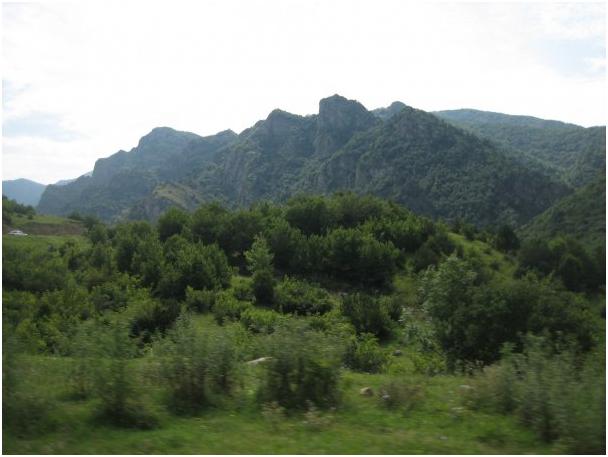
I have a friend who once told me, “It’s impossible to take a bad picture in Armenia”. Well, she’s right. This is somewhere in the Tavoush marz, just one of a thousand and one amazing landscapes across the Homeland.

You know, it was only a day, and I have been to Tbilisi before, but I got unclear impressions, strange “vibes” from Georgia this time. Continue reading