Turkish Review occasionally opens its doors to students from outside Turkey, inviting them to stay for brief internships at our journal. This summer we were joined by Nareg Seferian, a young Armenian of Marashtsi lineage (that is, with Armenian roots in Ottoman Maraş) who received his education in India, Armenia and the US, where his studies have focused on law and diplomacy. During his time with Turkish Review, Nareg visited his ancestral town of Marash/Maraş. This is his account of that journey. Continue reading
The Latin Lovers of Armenia
Among the samples of Yerevan’s architecture is the bridge at the end of Kievian Street.
 It unfortunately has the reputation of being a favourite drop-off point for the suicides of the city. Walking across it the other day, however, I saw a series of markings on the railings that evoke happier times and thoughts.

It appears that there is a young man who is quite infatuated with a young lady. So infatuated, in fact, that he can barely express his words … Continue reading
‘Democracy, Islam, and Secularism in Turkey’, By Ahmet T. Kuru and Alfred Stepan
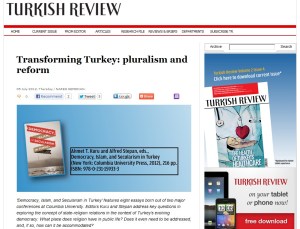
‘Democracy, Islam, and Secularism in Turkey’, By Ahmet T. Kuru and Alfred Stepan
‘Democracy, Islam, and Secularism in Turkey’ features eight essays born out of two major conferences at Columbia University. Editors Kuru and Stepan address key questions in exploring the concept of state-religion relations in the context of Turkey’s evolving democracy: What place does religion have in public life? Does it even need to be addressed, and, if so, how can it be accommodated?
Let it be said once more: Turkey has changed a lot in recent years, especially over the course of the past decade. Alongside the nation’s economic growth, its society has witnessed significant transformations that have affected the way it views itself, as well as the way the world sees it.
What the Justice and Development Party (AK Party) has brought about is not simply policies that encourage the generation of wealth or more proactive steps in diplomacy. Turkey is undergoing a philosophical shift. Things are changing in a way that does not just make people feel better about themselves as Turks or as citizens of Turkey; rather, they are being made to re-evaluate the very basis of the Turkish state — what it means, where it has been, where it is headed. And that is not always an easy task, especially given étatisme’s importance as a tenet in the foundation and organization of the Republic of Turkey. Questioning the heretofore unquestionable can provoke powerful challenges. Continue reading
A ‘Close Creative Encounter’ between İstanbul and Yerevan
 A ‘Close Creative Encounter’ between İstanbul and Yerevan
A creative format born in Japan that allows people to present and discuss ideas recently helped foster creative dialogue between two neighboring peoples who do not always see eye-to-eye: Turks and Armenians.
Pecha Kucha — Japanese for “chit-chat” — was conceived by two architects in Tokyo in 2003, originally as a means for young designers to showcase their work while giving them a chance to meet and network with one another. It has since grown immensely in popularity, with presenters from all artistic genres, and even academia, participating in regular franchised Pecha Kucha Nights in over 500 cities around the world.
Two of those cities are İstanbul and Yerevan. Organized with the support of USAID, the Eurasia Partnership Foundation and the Global Political Trends Centre at İstanbul Kültür University, the Yerevan Pecha Kucha franchisee — associated with Yerevan’s The Club, a well-known eatery that is not just a restaurant, but also a gallery and gathering space — worked together with the İstanbul franchisee, 34 Solo, a design consultancy, to put together what was described as “probably the first” inter-city, international Pecha Kucha Night, entitled “Close Creative Encounters.” Continue reading
A Good Day for Homophobia in Yerevan
 A Good Day for Homophobia in Yerevan
There has been much talk of the LGBTI community in Armenia lately. A bar, widely considered to be a gathering spot for those who think and act differently than most in this country, was recently firebombed and vandalized. The violence was condemned in large part only by the LGBTI community and its supporters, until two ARF MPs acted on behalf of the assailants, posting bail for them pending trial. That gave way to greater attention and greater condemnation, particularly in the diaspora—including by several leaders and opinion-makers associated with the ARF.
Partly in response to that event, a conference on LGBTI tolerance issues took place in Armenia last week. It was poorly attended–perhaps by 20 or 30 people at most–though supported by European bodies and the UN. And on Mon., May 21, a rally in support of diversity and tolerance was planned on the occasion of the World Day for Cultural Diversity for Dialogue and Development, but also not too far on the calendar from the International Day Against Homophobia and Transphobia, which is marked on May 17. Both events were spearheaded by an NGO known as PINK (“Public Information and Need of Knowledge”), alongside other civil society groups.
Song and dance moves to Armenia
 Song and dance moves to Armenia
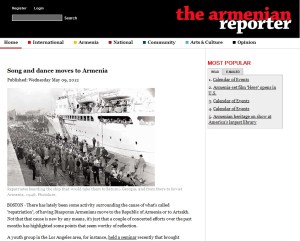
BOSTON – There has lately been some activity surrounding the cause of what’s called “repatriation”, of having Diasporan Armenians move to the Republic of Armenia or to Artsakh. Not that that cause is new by any means, it’s just that a couple of concerted efforts over the past months has highlighted some points that seem worthy of reflection.
A youth group in the Los Angeles area, for instance, held a seminar recently that brought together interested parties and organisations that do work in Armenia. Such activities are truly informative and helpful to the community out there. But the sort of effusive representation of life and times in Armenia that comes up and of “repatriation” can sometimes be a little over the top. Continue reading
Armenian Parliamentary Elections 2012: The Fletcher Connection
 Armenian Parliamentary Elections 2012: The Fletcher Connection
Armenians go to the polls to elect their fifth National Assembly on Sunday, May 6. Since its independence in 1991 after the fall of the Soviet Union, Armenia has suffered from rampant corruption and bureaucratic ineptitude in addition to larger economic issues and a devastating 1988 earthquake. Moreover, a territorial dispute involving neighboring Azerbaijan and a troubled historical legacy with Turkey have sealed shut a majority of the landlocked country’s borders.
Suffice it to say, then, that the Republic of Armenia has more than its fair share of domestic and international issues. Unfortunately, national and local voting has proven to be among them. The credibility of most Armenian governments has been wanting due to lackluster elections. Most politicians likewise fail to inspire confidence in the people.
Genocide Politics and People Power
 Genocide Politics and People Power
Thoughts from Ahmet Altan’s Lecture at ALMA
On Saturday evening, Jan. 28, the Armenian Library and Museum of America (ALMA) in Watertown hosted Ahmet Altan, the editor of the liberal Turkish newspaper Taraf, well known in Armenian circles as it often publishes material pertinent to and resonating with our cause. The event was organized by the Friends of Hrant Dink, in the memory of that seminal figure gunned down five years ago. After remarks by Barbara Meguerian and Harry Parsekian, noted historian Taner Akcam of Clark University praised the speaker for his work and went so far as to refer to Taraf as something of a political party, since it serves as a powerful outlet for the voice of the opposition in Turkey.
“73. Waverley.”
“73. Waverley.”
I could see from the top of the stairs that one of my buses was waiting. Someone had just come out of the turnstiles from the metro at Harvard and was making a mad dash for the lower bus tunnel. We were both underground. He could see the bus from where he was. I could see him.
I did not want to make a run for it, however. For one, it’s a little undignified, I find, and, well, I was in no hurry. Sure, I’d miss that bus and maybe wait ten or twelve minutes for another, maybe even less. Meanwhile, there’s a copy of Anna Karenina in my bag, halfway read, which means still a lot more to go. Continue reading
Following the Remarkable Footsteps of Our Merchant Ancestors
 Following the Remarkable Footsteps of Our Merchant Ancestors
CAMBRIDGE, Mass. (A.W.)–Sebouh Aslanian, the recently appointed assistant professor and Richard Hovannisian Term Chair in modern Armenian history at UCLA, lectured at Harvard on Sept. 14 on the fascinating story of the Armenian merchants of New Julfa (Nor Jugha). Stretching across the Mediterranean, down through the Indian Ocean and all the way to the Pacific, encompassing the Middle East, the Russian Empire, India and Tibet, and the Far East, the Julfa Armenians commanded a vast and active network of trade in early modern times.
 naregseferian.com