Glimpses into the ARF Photo Archives: Miscellaneous Surprises

Glimpses into the ARF Photo Archives: Miscellaneous Surprises

There is a lot that could be said and written about the ARF photo archives, which I have had the privilege and pleasure of sorting through over the course of the autumn and winter of 2023 and into 2024. Having already directed your gaze to a few concrete glimpses through the pages of the Weekly – whether more on the solemn or amusing side, or just pointing out a piece of history – this article shares a mixed bag of highlights from the collection which caught my eye.

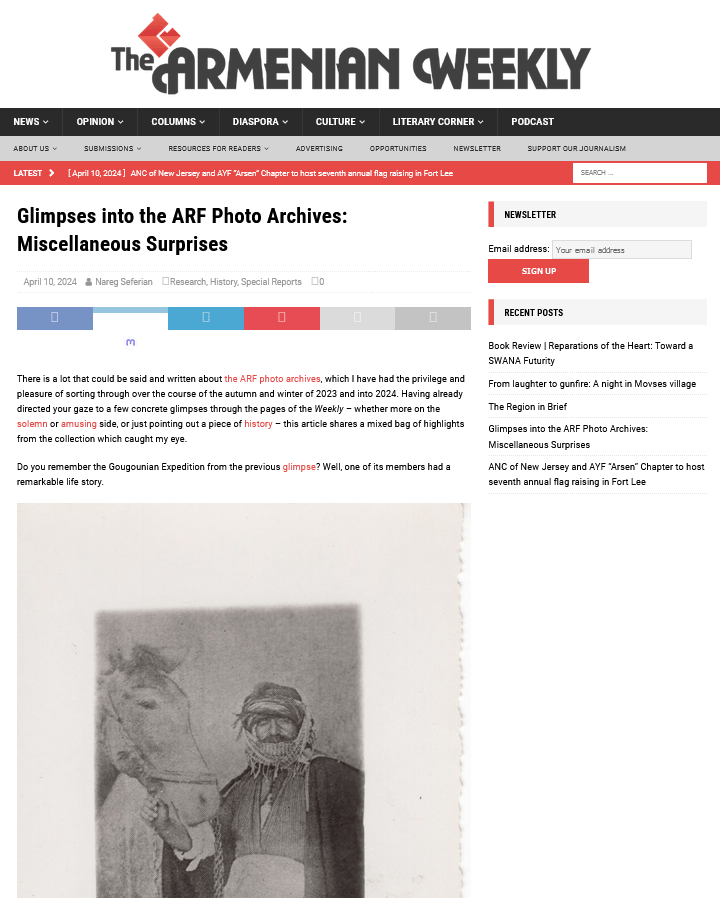
Do you remember the Gougounian Expedition from the previous glimpse? Well, one of its members had a remarkable life story.

read the rest

Glimpses into the ARF Photo Archives: The Gougounian Group

Glimpses into the ARF Photo Archives: The Gougounian Group

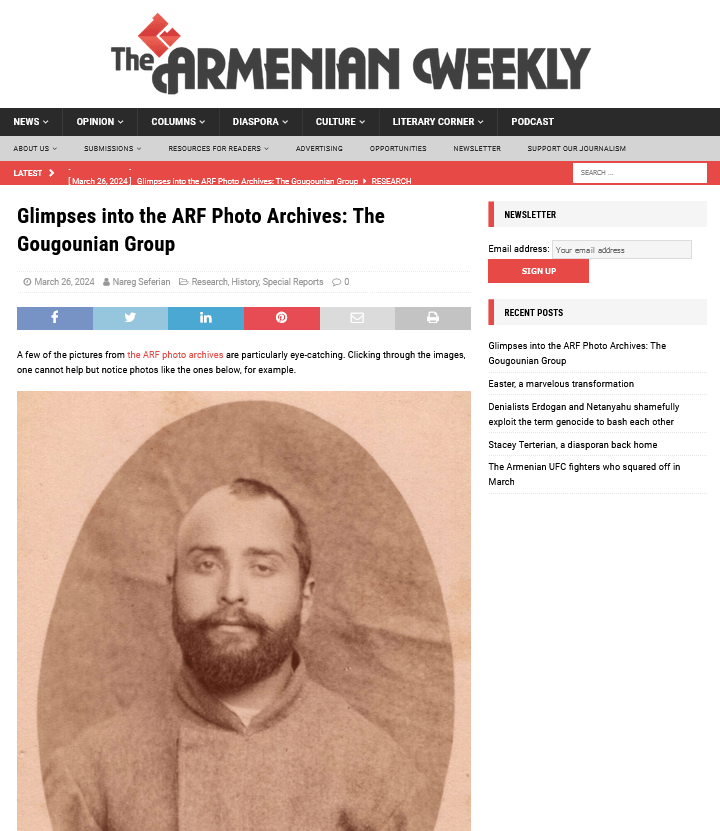
A few of the pictures from the ARF photo archives are particularly eye-catching. Clicking through the images, one cannot help but notice photos like the ones below, for example.

At first, it seems almost comical, as if it was a fad once upon a time for young men to shave the right half of their heads while keeping heavy beards and mustaches. Upon closer inspection, though, one notices a uniformity in what these men wore as well, and facial expressions that do not suggest a willful participation in the proceedings.

The captions and notes on the backs of the photos reveal the secret. These are four participants of the Gougounian Expedition – a tale from the turn of the 20th century worthy of a movie that has more or less gotten lost in the epic history of the Armenian people.

read the rest

Glimpses into the ARF Photo Archives: Armenian Legionnaires Immortalized

Glimpses into the ARF Photo Archives: Armenian Legionnaires Immortalized

In this series of brief glimpses into the ARF photo archives, I have tried to share with you thought-provoking, fun or other kinds of take-aways from the collection. This article is about a more specific episode of Armenian history – the Armenian Legion of 1916-1920 and its heroic volunteers, or gamavors.

Originally formed as the Légion d’Orient under French command, the units evolved into the Légion Arménienne serving alongside French and British forces as they fought Ottoman troops at the end of the First World War, moving up the Levant or eastern coast of the Mediterranean. The Western powers took over the Holy Land, Lebanon, Syria and Cilicia thanks to the efforts of the Armenian Legion among their ranks.

read the rest

Glimpses into the ARF Photo Archives: Armenians and Their Neighbors

Glimpses into the ARF Photo Archives: Armenians and Their Neighbors

In my previous articles delving into photographs from the ARF Archives, we saw some familiar and unfamiliar visuals from our history and culture over the past century and more. One clear takeaway is that the Armenian people have never lived in a vacuum. Empires have passed over the lands where Armenians have lived. Large-scale conflicts have reverberated among the Armenian people, not least of which the Genocide during the First World War. Armenians themselves have also participated in and helped shape fashions and trends around them – including, not coincidentally, the spread of photography in the Middle East.

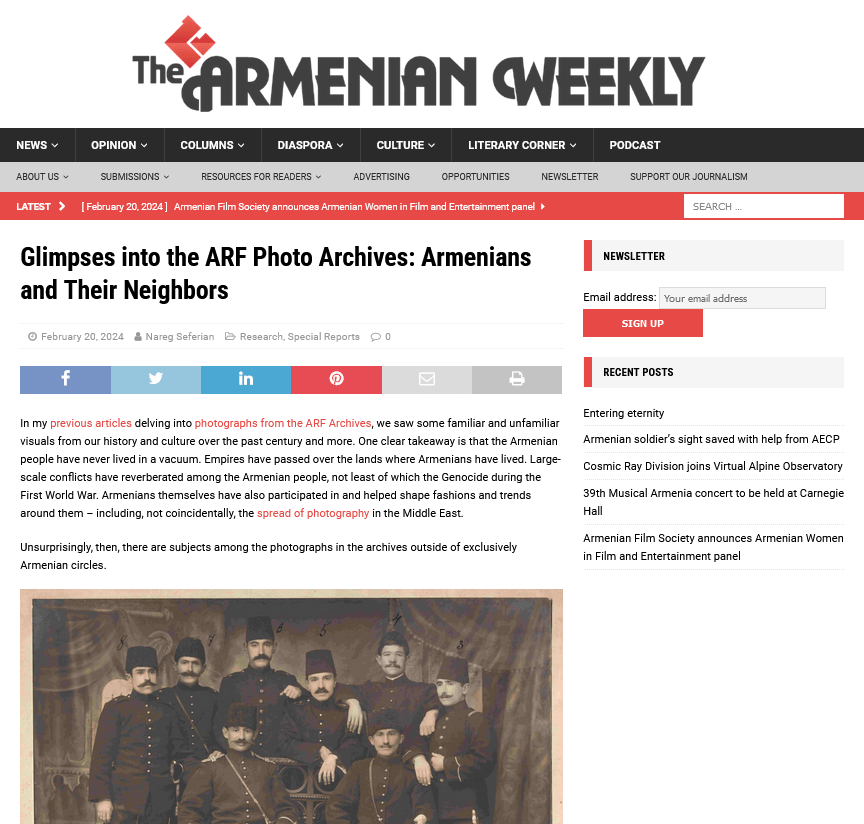
Unsurprisingly, then, there are subjects among the photographs in the archives outside of exclusively Armenian circles.

read the rest

Glimpses into the ARF Photo Archives: Pains of the Past

Glimpses into the ARF Photo Archives: Pains of the Past

In my previous look into photographs from the ARF archives, I pointed out two things: first, there is a lack of information on many items in the collection – inviting you all to contribute, if you can – and, second, men (and their mustaches) dominate many of the images.

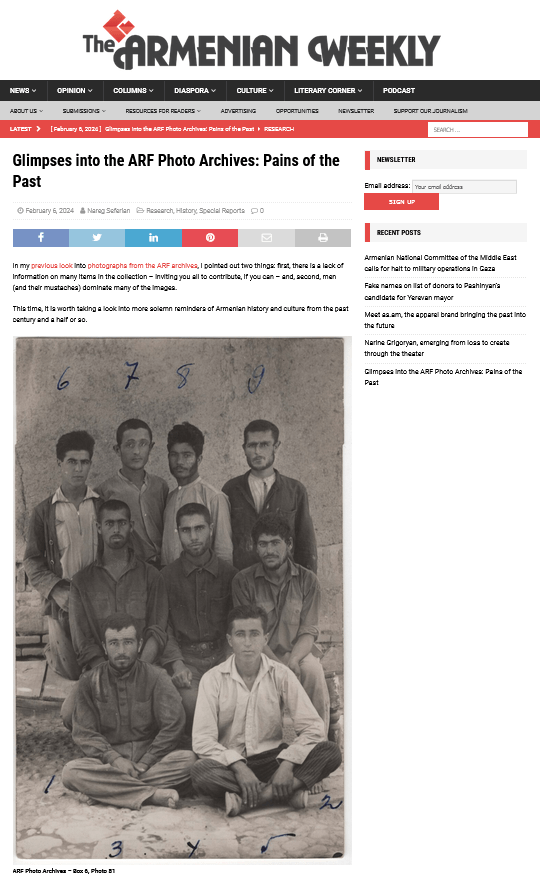
This time, it is worth taking a look into more solemn reminders of Armenian history and culture from the past century and a half or so.

read the rest

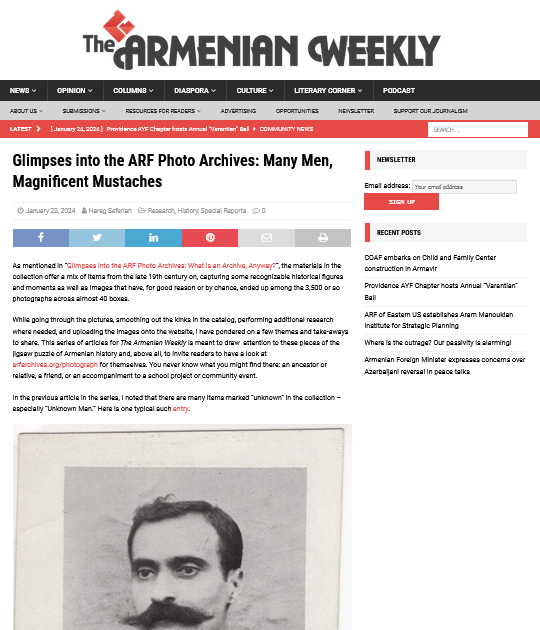
Glimpses into the ARF Photo Archives: Many Men, Magnificent Mustaches

Glimpses into the ARF Photo Archives: Many Men, Magnificent Mustaches

As mentioned in “Glimpses into the ARF Photo Archives: What is an Archive, Anyway?”, the materials in the collection offer a mix of items from the late 19th century on, capturing some recognizable historical figures and moments as well as images that have, for good reason or by chance, ended up among the 3,500 or so photographs across almost 40 boxes.

While going through the pictures, smoothing out the kinks in the catalog, performing additional research where needed, and uploading the images onto the website, I have pondered on a few themes and take-aways to share. This series of articles for The Armenian Weekly is meant to draw  attention to these pieces of the jigsaw puzzle of Armenian history and, above all, to invite readers to have a look at arfarchives.org/photograph for themselves. You never know what you might find there: an ancestor or relative, a friend, or an accompaniment to a school project or community event.

read the rest

Glimpses into the ARF Photo Archives: What is an Archive, Anyway?

Glimpses into the ARF Photo Archives: What is an Archive, Anyway?

For the past few months, I have had the great privilege of working through the collection of over 3,500 photographs in the archives of the Armenian Revolutionary Federation (ARF).

The photographs have been meticulously scanned and thoroughly cataloged already by some colleagues. My job has been to go through the list, fix or fine-tune whatever needs an extra pair of eyes – at times involving some engaging and surprising supplementary research – and upload the images onto the photographs section of the website. Some finishing touches have often been further supplied by more colleagues still. It is a real team effort.

Now that we are past the 1,500 mark of uploaded photographs, I have put together a few brief articles for the pages of the Weekly highlighting some themes and takeaways from the collection. This venerable newspaper has shared insights from the ARF Archives on more than one occasion in recent years. Beyond anything else, I would like to invite readers to have a look at the images for themselves at arfarchives.org/photograph. Maybe you will find a great illustration for a report, a fun tidbit to share with family and friends, or a familiar face or two – relatives or ancestors, perhaps?

read the rest

This Tarkmanchats, let’s celebrate Armenian names

This Tarkmanchats, let’s celebrate Armenian names

My name is Nareg Hovsep Seferian.

It ends in “-ian” – characteristic for most Armenian surnames, also with its other spelling, “-yan.”

“Seferian.” That means “traveler.” My ancestors were probably merchants. Little surprise there for any Armenian. The sefer part is ultimately an Arabic root, but it surely became a surname for Armenians under Turkish or Persian rule. “Safarian” is another version. So, alongside the Armenian suffix, that surname reflects the mark of medieval and modern empires and neighboring cultures.

“Hovsep,” my middle name, is Armenian for “Joseph” – a name from the Bible, Hebrew via Greek. This is an indication of how Armenians have long formed part of the broader cultural landscape around the Mediterranean and Middle East. It also indicates the Christian heritage which forms a significant part of the Armenian identity. It is my father’s name. And my nephew’s name – the first-born grandson of my immediate family. That tells you something about naming practices prevalent in Armenian culture.

read the rest

Book Review: The Dreamt Land

Book Review: The Dreamt Land

The Dreamt Land: Chasing Water and Dust Across California
By Mark Arax
2019
576 pp., Knopf
$21.23 hardcover

For two summers in a row, I had the privilege of acting as an interpreter for a team of auditors of an international development organization which was involved in a reservoir and irrigation project in Armenia. My two big memories from that experience were the adage, “Water is life” and how rural individuals and groups in Armenia had it in them to get organized and advocate for themselves in the face of a rather rigid government and a major global donor. It was moving and impressive.

The Dreamt Land by Mark Arax has numerous such tales to share in the continuing saga of “Water is life” across a territory about 15 times the size of Armenia with a history of pipelines, wells, irrigations, dams and claims and counter-claims on land and land use that date back two centuries. The book is in part a history of California told through its management of water and other natural resources and a compilation of investigative reporting pieces, alongside profiles of notable figures past and present. There’s also plenty of social commentary, as well as autobiographical elements. It is a lengthy piece of writing – sometimes disjointed, often very much detailed – but always revolving around the same key question: Who gets to decide what to do with the land and the water in California, how and why?

read the rest

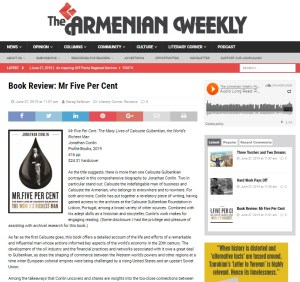
Book Review: Mr Five Per Cent

Book Review: Mr Five Per Cent

Mr Five Per Cent: The Many Lives of Calouste Gulbenkian, the World’s Richest Man
Jonathan Conlin
Profile Books, 2019
416 pp.
$24.31 hardcover

As the title suggests, there is more than one Calouste Gulbenkian portrayed in this comprehensive biography by Jonathan Conlin. Two in particular stand out: Calouste the indefatigable man of business and Calouste the Armenian, who belongs to everywhere and to nowhere. For both and more, Conlin has put together a revelatory piece of writing, having gained access to the archives at the Calouste Gulbenkian Foundation in Lisbon, Portugal, among a broad variety of other sources. Combined with his adept skills as a historian and storyteller, Conlin’s work makes for engaging reading. (Some disclosure: I had the privilege and pleasure of assisting with archival research for this book.)

As far as the first Calouste goes, this book offers a detailed account of the life and efforts of a remarkable and influential man whose actions informed key aspects of the world’s economy in the 20th century. The development of the oil industry and the financial practices and networks associated with it owe a great deal to Gulbenkian, as does the shaping of commerce between the Western world’s powers and other regions at a time when European colonial empires were being challenged by a rising United States and an upstart Soviet Union.

read the rest