The problem of co-ordinating Armenian efforts
The problem of co-ordinating Armenian efforts

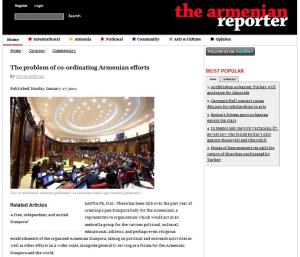
SANTA FE, N.M. – There has been talk over the past year of creating a pan-Diaspora body for the Armenians, a representative organisation which would act as an umbrella group for the various political, cultural, educational, athletic, and perhaps even religious establishments of the organised Armenian Diaspora, taking on political and outreach activities as well as other efforts on a wider scale, alongside generally serving as a forum for the Armenian Diaspora and the world. Continue reading

A new name for an ancient region

A new name for an ancient region

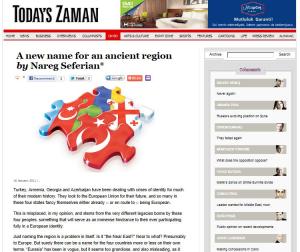
Turkey, Armenia, Georgia and Azerbaijan have been dealing with crises of identity for much of their modern history. They look to the European Union for their future, and so many in these four states fancy themselves either already — or en route to — being European.

This is misplaced, in my opinion, and stems from the very different legacies borne by these four peoples, something that will serve as an immense hindrance to their ever participating fully in a European identity.

Continue reading

Genocide Politics: Players, Moves and An Endgame

Genocide Politics: Players, Moves and An Endgame

The issue of the events involving Armenians and Turks at the end of the nineteenth and the beginning of the twentieth century has gained political currency over the past few decades. It involves a number of players: the Republic of Turkey, the organized Armenian Diaspora, the Republic of Armenia, the Armenians of Turkey, the Republic of Azerbaijan, and the nascent émigré groups of Turks and Azerbaijanis in the West. Whereas the Armenian parties must consolidate their efforts and present a united front, the greater onus lies on Turkey as the biggest and most significant player to achieve a lasting resolution.

read the rest

The Organisational Crisis of the Armenian Nation

The Organisational Crisis of the Armenian Nation

With the wonders of modern technology, I managed to follow the symposium held recently at the University of Southern California on the potential of a trans-national, democratic Armenian Diaspora body. The six-hour long event can be viewed at http://capture.usc.edu/mediasite/Viewer/?peid=555571291d934fcfb6650cb76ebe456d1d.

Let me confess at the outset not to have listened word-for-word to each presenter. I did go through the entire proceedings, however, and my reaction is a reflection of the same general concerns expressed early on this year, when Harout Sassounian published a piece proposing such a body, as did Policy Forum Armenia, a Washington, DC-based think-tank led by David Grigoryan. (Mr. Sassounian was himself a presenter at this symposium, while Mr. Grigoryan, following it online, managed to have a proxy express his thoughts at the event.)

In my opinion, there were two, somewhat minor, aspects of the symposium which were disappointing. For one, although most of the speakers were not American-born and were well-versed in the Armenian language, the presentations and most of the question and answer period, with some exceptions, took place in English. I realise that not all those present knew Armenian, and that it would have meant extra cost and trouble to have a simultaneous translator, but, all the same, I felt it lent an air of artificiality to many of the speakers, especially to those who had trouble with English as well. Simultaneous translations, by contrast, are available at most such public events in Armenia. I know that English is not current in the Republic, but I am not sure how current it is in the Diaspora, either. Continue reading

A free, independent, and united Diaspora?

A free, independent, and united Diaspora?

SANTA FE, N.M. – Within days of one another, prominent activist and columnist Harut Sassounian and Policy Forum Armenia (PFA), a think tank, issued proposals for a trans-national representative organization for the Armenian Diaspora. Continue reading