“Der Matossian, Bedross, The Horrors of Adana: Revolution and Violence in the Early Twentieth Century, (Stanford University Press, 2022).” The Armenian Review, Number 1-2 (Spring-Summer, 2023).
All | Ամբողջը
Azerbaijan’s use of force in Nagorno-Karabakh risks undermining key international norms, signaling to dictators that might makes right

The United States’ top humanitarian aid representative, Samantha Power, was dispatched on a fact-finding mission on Sept. 26, 2023, to a registration point on the border with Armenia for those fleeing the Armenian-populated enclave of Nagorno-Karabakh. What she found was frustration: “Sanction Azerbaijan or go back to your country! We don’t care. Stop the lies!” someone shouted in a mid-press conference interruption.
Underscoring the gravity of the situation, Power’s visit coincided with a fuel depot explosion across the border in the disputed territory that killed at least 68 people, with 105 reported missing.
As an Armenian scholar of international affairs, I see the anger directed at Power reflecting two realities: the worsening plight of Armenians in Nagorno-Karabakh and the perceived inaction of the international community. Should the authoritarian regime in Azerbaijan be allowed to act with impunity in Nagorno-Karabakh, then I fear it will only further erode the international principle of nonuse of force.
Nagorno-Karabakh peace negotiations between Armenia and Azerbaijan end without agreement
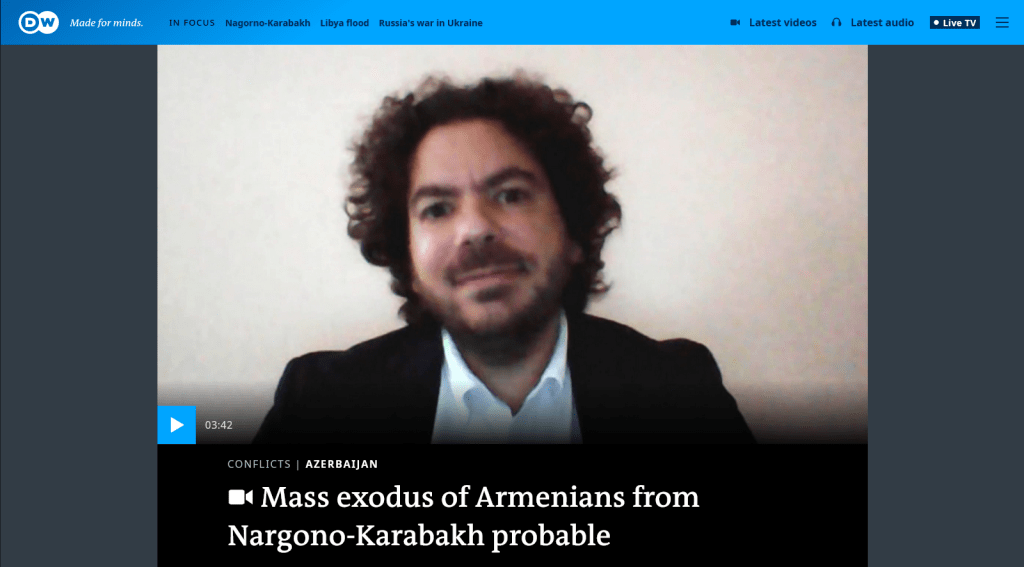
Mass exodus of Armenians from Nagorno-Karabakh probable
Renewed Violence in Nagorno-Karabakh: An Endgame or More Instability to Come?
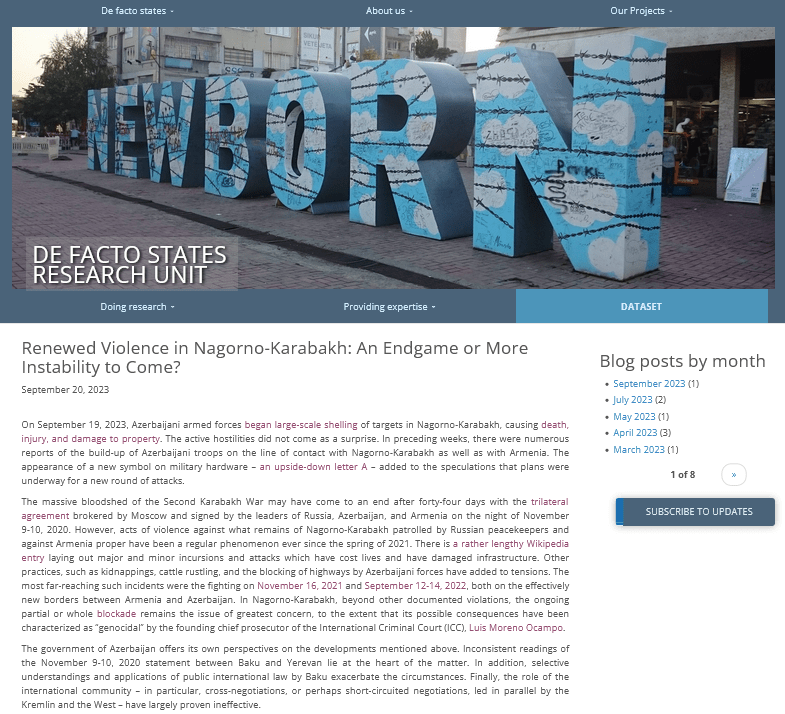
Renewed Violence in Nagorno-Karabakh: An Endgame or More Instability to Come?
On September 19, 2023, Azerbaijani armed forces began large-scale shelling of targets in Nagorno-Karabakh, causing death, injury, and damage to property. The active hostilities did not come as a surprise. In preceding weeks, there were numerous reports of the build-up of Azerbaijani troops on the line of contact with Nagorno-Karabakh as well as with Armenia. The appearance of a new symbol on military hardware – an upside-down letter A – added to the speculations that plans were underway for a new round of attacks.
The massive bloodshed of the Second Karabakh War may have come to an end after forty-four days with the trilateral agreement brokered by Moscow and signed by the leaders of Russia, Azerbaijan, and Armenia on the night of November 9-10, 2020. However, acts of violence against what remains of Nagorno-Karabakh patrolled by Russian peacekeepers and against Armenia proper have been a regular phenomenon ever since the spring of 2021. There is a rather lengthy Wikipedia entry laying out major and minor incursions and attacks which have cost lives and have damaged infrastructure. Other practices, such as kidnappings, cattle rustling, and the blocking of highways by Azerbaijani forces have added to tensions. The most far-reaching such incidents were the fighting on November 16, 2021 and September 12-14, 2022, both on the effectively new borders between Armenia and Azerbaijan. In Nagorno-Karabakh, beyond other documented violations, the ongoing partial or whole blockade remains the issue of greatest concern, to the extent that its possible consequences have been characterized as “genocidal” by the founding chief prosecutor of the International Criminal Court (ICC), Luis Moreno Ocampo.
The government of Azerbaijan offers its own perspectives on the developments mentioned above. Inconsistent readings of the November 9-10, 2020 statement between Baku and Yerevan lie at the heart of the matter. In addition, selective understandings and applications of public international law by Baku exacerbate the circumstances. Finally, the role of the international community – in particular, cross-negotiations, or perhaps short-circuited negotiations, led in parallel by the Kremlin and the West – have largely proven ineffective.
The Eagle in the South Caucasus: Armenia Tests Alternative Geopolitical Waters

The Eagle in the South Caucasus: Armenia Tests Alternative Geopolitical Waters
Walter Landgraf, Nareg Seferian
- The US-Armenia “Eagle Partner” joint military exercise from September 11–20 may signal the beginning of a shift in the foreign policy direction of Armenia, historically a close ally to Russia.
- Armenia has been growing frustrated at the lackluster response of the Collective Security Treaty Organization to its appeals for assistance in the deepening conflict with Azerbaijan.
- However, it would be difficult to imagine a wholesale change in the geopolitical orientation in Yerevan, given the strong military, economic, energy, and cultural ties between Armenia and Russia.
On September 11, US and Armenian troops kicked off the “Eagle Partner” joint military exercise at the Zar and Armavir training sites near Yerevan. The exercise is set to run for ten days and is relatively low-key, involving only 175 Armenian troops and eighty-five US soldiers—that is about the size of a very small US Army company. According to the US Army Europe and Africa, the command responsible for overseeing Army operations there, the soldiers are from the 1st Brigade, 101st Airborne Division and the Kansas Army National Guard. The latter has had a bilateral partnership with Armenia under the National Guard Bureau’s State Partnership Program since 2003. The stated goal of the exercise is to enhance US-Armenian interoperability and prepare Armenian troops for possible future peacekeeping operations.
Nagorno-Karabakh Conflict – Overview, Analysis, Resources
Nagorno-Karabakh Conflict – Overview, Analysis, Resources
Hello. My name is Nareg Seferian. I recently completed my doctoral studies at the School of Public and International Affairs at Virginia Tech.
Part of my dissertation had to do with the Nagorno-Karabakh conflict.
I wanted to make this video for a few reasons, mainly to present an overview of the dispute – a backgrounder or explainer.
Right at the outset I have to emphasise that, as with many conflicts around the world, the dispute over Nagorno-Karabakh is complex. It has numerous dimensions. There are many sensitive layers to it which I will not address in this video.
I intend to provide some general information, offer a little bit of analysis, and suggest some resources for those interested in learning more.
Continue readingGenocide resisters, long overlooked by history, step into the spotlight

Genocide resisters, long overlooked by history, step into the spotlight
The anniversary of the Armenian Genocide is marked every year on April 24. That was the date in 1915 when hundreds of Armenian community leaders were arrested by the government of the Ottoman Empire in the capital Constantinople, now known as Istanbul.
At the time, Armenians lived throughout what is modern-day Turkey. Modern scholars estimate up to 1.5 million Armenians were killed by the Turkish government, and around 800,000 to 1.2 million were deported during World War I. Most ended up in the Middle East, the Caucasus, Russia, Europe and the Americas. During that period, Greek, Assyrian and Yezidi communities were also massacred and forced to flee into exile.
Suddenly a borderland: The new borderization between Armenia and Azerbaijan
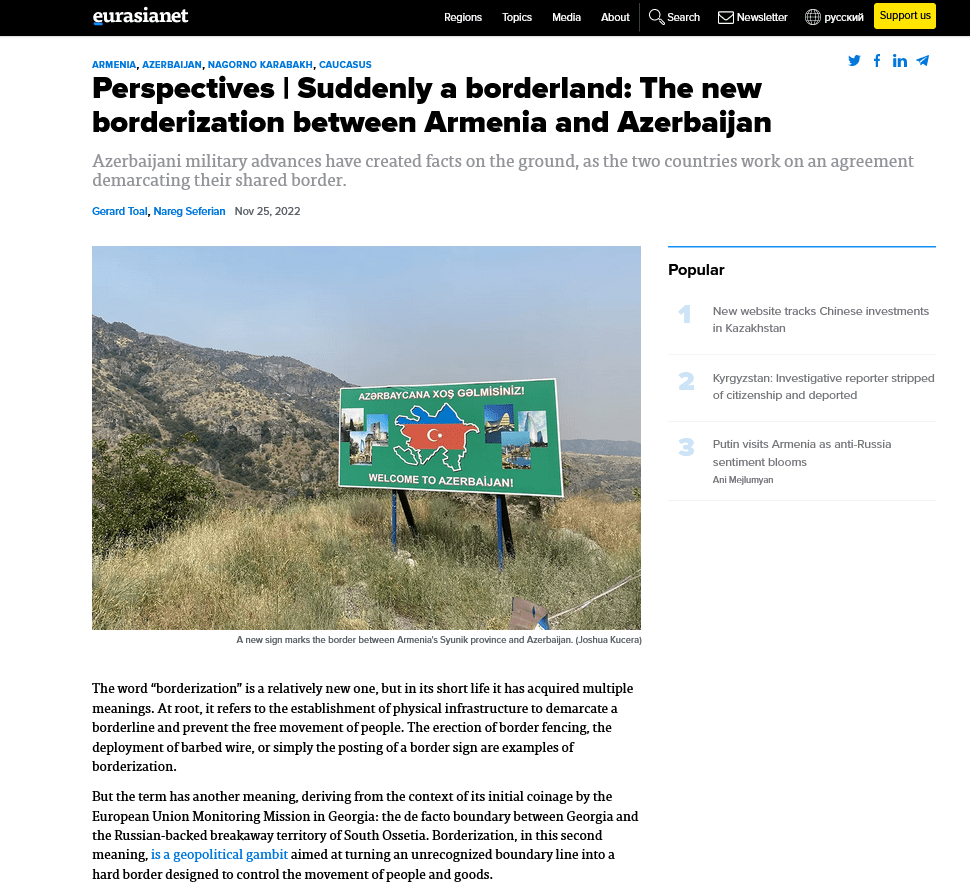
Suddenly a borderland: The new borderization between Armenia and Azerbaijan
Gerard Toal, Nareg Seferian
The word “borderization” is a relatively new one, but in its short life it has acquired multiple meanings. At root, it refers to the establishment of physical infrastructure to demarcate a borderline and prevent the free movement of people. The erection of border fencing, the deployment of barbed wire, or simply the posting of a border sign are examples of borderization.
This Tarkmanchats, let’s celebrate Armenian names

This Tarkmanchats, let’s celebrate Armenian names
My name is Nareg Hovsep Seferian.
It ends in “-ian” – characteristic for most Armenian surnames, also with its other spelling, “-yan.”
“Seferian.” That means “traveler.” My ancestors were probably merchants. Little surprise there for any Armenian. The sefer part is ultimately an Arabic root, but it surely became a surname for Armenians under Turkish or Persian rule. “Safarian” is another version. So, alongside the Armenian suffix, that surname reflects the mark of medieval and modern empires and neighboring cultures.
“Hovsep,” my middle name, is Armenian for “Joseph” – a name from the Bible, Hebrew via Greek. This is an indication of how Armenians have long formed part of the broader cultural landscape around the Mediterranean and Middle East. It also indicates the Christian heritage which forms a significant part of the Armenian identity. It is my father’s name. And my nephew’s name – the first-born grandson of my immediate family. That tells you something about naming practices prevalent in Armenian culture.
 naregseferian.com